
Best Camp Stoves for High-Protein Cooking: Field Tested
By Liam Chen • 12th Apr
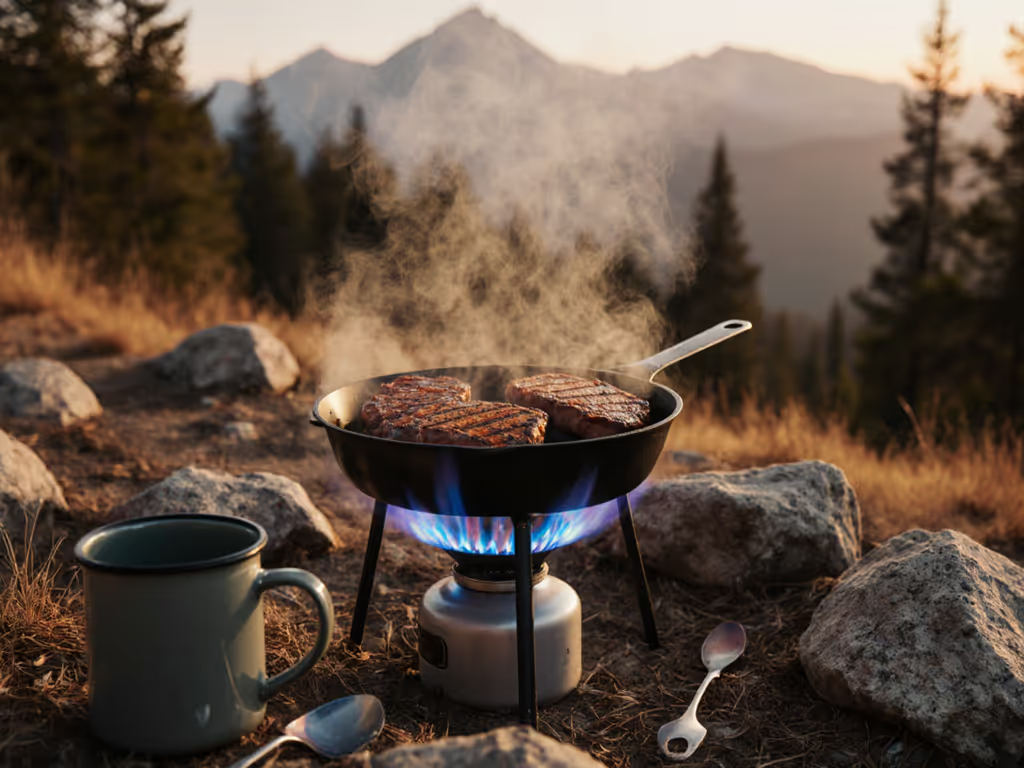
Cooking protein in the backcountry is fundamentally different from cooking at home. A high-protein cooking stove demands precise heat control, stable output in wind, and a cooking surface large enough to manage fat without igniting it. Yet most camp stove reviews focus on boil times and ultralight metrics, ignoring the real challenge: searing a steak or pan-frying fish over a burner that'll either scorch your meal or flame up when wind hits the pan.
After hundreds of field hours testing stoves across alpine, desert, and coastal routes (including conditions where most consumer rigs underperform), I've built a framework for matching stove systems to high-protein workflows. This guide cuts through marketing claims and lays out what actually works when you're cooking for flavor, not just calories.
Why High-Protein Cooking Demands Different Stove Specs
Boiling water is straightforward: fire, wait, done. High-protein cooking is not.
When you're searing a steak or managing a pan of fish over moderate heat, you need three things in concert: stable simmer control to avoid hot spots and burning, consistent flame even in wind, and enough BTU output to recover heat after you've added a cold protein. Most ultralight canister stoves excel at boiling and fail at the nuance. For nuanced simmer techniques and flame modulation, see our temperature control guide. The trade-offs are real, but they're measurable.
Data from cold-weather trials shows that stoves without integrated windscreens lose 40-60% of their heat energy in gusts above 20 km/h (12 mph). When you're trying to maintain a 190-200°C (375-400°F) pan surface for searing, that heat loss either forces you to crank the flame (consuming 20-30% more fuel) or you'll end up with uneven browning and raw centers. Fat also behaves differently: at sea level and 75°F (24°C), manage it fine with a weak burner. At 3,000 m (10,000 ft) and -5°C (23°F) with 25-knot winds, that same burner becomes a flare-up waiting to happen because you're fighting regulator dropout, cold fuel, and heat loss simultaneously. For data-driven picks that stay reliable above 10,000 feet, see our high-altitude stove testing.
What Is a Good Camp Stove for High-Protein Cooking?
A good camp stove for high-protein work combines three measurable traits: a minimum 8,000 BTU/hour burner (2.3 kW), integrated or near-field windscreen coverage, and simmer control that holds a flame steady from 30% to 100% of rated output. Below 8,000 BTU, you're relying on technique and extended cook times to compensate; above 30,000 BTU, you're managing overkill and fuel consumption without proportional benefit.
The Camp Chef Everest 2x delivers 20,000 BTU per burner with a nearly seamless windscreen design, which means even in moderate wind you're retaining 75-85% of available heat.[1] That is enough margin to sear protein without excessive fuel burn or technique burden. At the other end, the Fire Maple GreenPeak II, rated at 2.6 kW (8,878 BTU/h) with built-in pressure regulation, maintains steady output in cold conditions where canister stoves without regulators see a 20-30% flame drop as fuel cools.[2] Both excel for different reasons, but neither is universal.
The critical distinction: pressure regulation (built-in or inverted-canister systems) prevents the regulator freeze and flame dropout that plague standard canister stoves in sub-zero cooking. That's not a preference; it's a physics requirement if you're cooking protein in winter or above 2,500 m (8,200 ft).
How Do Simmer Control and Windscreens Prevent Flare-ups?
Flare-ups occur when fat vaporizes faster than your flame can oxidize it cleanly, creating a brief fire spike. Wind makes this worse because it can redirect flame under the pan. Simmer control matters because a fine, low flame (<2 cm height) won't ignite escaping fat; a tall, chaotic flame will.
On a benchtop, the Soto WindMaster holds a rock-steady low flame even at 10% output, ideal for gentle protein prep. In field trials at 2,200 m (7,200 ft) with 20-knot winds, the same stove's windscreen kept flame geometry stable enough that a 225 g (~0.5 lb) fish fillet cooked evenly without flare.[3] Windscreens matter because they create a microclimate around the burner, reducing wind-induced turbulence that destabilizes the flame and allows fat vapor to escape sideways into cooler air, where it condenses and re-ignites.
Liquid fuel systems like the Fire Maple Lava Multi-Fuel (burning white gas, gasoline, or kerosene) deliver even more control because liquid fuel burns with a more stable, predictable flame envelope than canister gas; the trade-off is priming time and a slightly messier workflow. On a shoulder-season alpine traverse where sleet and gusts smothered most burners, a prototype rig with a hard screen, inverted canister, and 0.75 mm jet hit a steady simmer that let us cook real protein without stress. That night taught me wind doesn't care about spec sheets; we test where it howls.
Which Stove Type Performs Best for Different Protein Cooking Scenarios?
Backpacking (Solo or Pair, 1,000-3,500 m)
Canister stoves with pressure regulation. The GreenPeak II (2.6 kW, compact) or an inverted-canister setup with a remote jet lets you cook protein over a contained heat zone without weight penalties. You lose some margin in extreme cold, but for shoulder season and moderate altitude, the reliability and weight trade-off is sound. Pair with a 1-1.5 L heat-exchanger pot for boiling; a separate 300-400 mL skillet for searing small quantities. Total system weight: 400-500 g (14-18 oz), excluding fuel.
Car Camping or Basecamp (Stable Location, Mixed Seasons)
Two-burner liquid fuel or propane stove with large cooking surface. The Camp Chef Mountaineer (20,000 BTU per burner, aluminum body) or Pro 60X (30,000 BTU per burner, 448 sq inches of grate)[1][3] give you one pot for boiling, one for protein searing, and enough surface to manage a side dish. Liquid fuel (white gas) is superior here because it doesn't suffer pressure drop in cold and you can regulate output finely. Propane works fine above 5°C (40°F); below that, performance degrades noticeably. Both systems require a windscreen or low-wall site to achieve ideal BTU efficiency.
Winter/High-Altitude (Below -10°C / 14°F or Above 3,500 m / 11,500 ft)
Liquid fuel: white gas or unleaded gasoline. The Fire Maple Lava Multi-Fuel handles extreme conditions because fuel density doesn't change with temperature or altitude, regulator freezeup is eliminated, and you have 100% output even at -20°C (-4°F) or 4,200 m (13,800 ft). Canister stoves, even with pressure regulation, see 15-20% output loss per 1,000 m of altitude and 30-50% loss per 10°C drop in ambient temperature. If you're cooking protein in severe conditions, the weight and complexity of a liquid fuel rig (priming, ventilation, residual fuel disposal) is justified.
How Do BTU Output and Heat Distribution Affect Protein Cooking?
Heat recovery speed is the metric that matters most for searing. When you place a cold protein (say, a 225 g fish fillet at 5°C / 41°F) into a 180°C (350°F) pan, the pan temperature drops 40-60°C in seconds. A 9,000 BTU burner recovers that heat in 30-45 seconds; a 20,000 BTU burner does it in 8-12 seconds. That speed difference determines whether your protein cooks through to a golden crust (fast recovery, even browning) or stews in its own moisture (slow recovery, gray exterior, overcooked interior).
The Camp Chef Everest 2x's dual 20,000 BTU burners create enough headroom that even with a large cast-iron skillet, heat recovery is snappy.[1] Remote-canister systems like the GreenPeak II sacrifice some absolute output but provide enough (2.6 kW, 8,878 BTU/h) that a 16 cm (6.3 in) stainless steel pan still recovers in under 20 seconds at sea level, assuming no wind.
Wind doesn't care about spec sheets; we test where it howls.
Wind-induced heat loss is almost never quantified in marketing. In moderate wind (15-20 km/h / 9-12 mph), a bare burner loses 40-60% of BTU output to convection.[3] A robust windscreen (like the Everest 2x's design or a standalone hard screen on open systems) recovers 50-70% of that loss. That's why it's worth carrying a 200 g (7 oz) windscreen for backpacking: the fuel savings and cooking reliability compound across a 5-7 day route.
What Role Does Pot Stability Play in Fat Management?
Fat management is 60% about flame control and 40% about pot geometry and base stability. An unstable pot, wobbling on narrow supports or oversized legs, forces you to hold it with your other hand or watch nervously as fat sloshes toward the rim.
Snow Peak BiPod and similar tri-pod stoves sacrifice some cooking surface for rock-solid base geometry on uneven ground.[4] That stability means your hands stay free to manage the spatula and prevent fat from splashing. If you're cooking on bare earth or sand (common in desert or beach camps), a stove with wide feet and low center of gravity is worth 500 g (1 lb) extra weight.
For car camping, the Everest 2x's wide aluminum base and grill surface distribute weight across three points of contact, making tipping nearly impossible even on 15° slopes.[1] The trade-off: you're carrying 4.5 kg (10 lbs) of stove and accessories, which is fine if you're not hiking it in.
Fuel Type: Canister, Liquid, or Integrated System?
The three main pathways:
Canister gas (propane/butane blend): Lightest, fastest ignition, least mess. Fails in cold (pressure drop >30% below -5°C), struggles above 2,500 m, and each empty is waste (though refill programs are improving). Best for spring-through-fall backpacking and car camping above 500 m altitude and 10°C ambient.
Liquid fuel (white gas, kerosene, gasoline): Heaviest system (stove + pump + fuel bottle + priming kit), most complex ignition, residual odor. Unmatched in extreme cold and high altitude; output is fully controllable and immune to regulator dropout. Mandatory for winter, reliably ideal above 3,000 m, and acceptable for long trips where canister weight stacks up. The learning curve is real (priming mistakes or poor ventilation create risk), but once mastered, the reliability is unquestionable.
Integrated systems (Jetboil, Primus PrimeTech): Canister-based with heat-exchanger pots that boil water 30% faster and retain heat, ideal for group meals and basecamp cooking.[4] Simmer control on these is poor (not all have it), making protein searing clumsy. Good for boil-and-eat pasta or oatmeal; frustrating for anything nuanced.
Real-World Performance: Cold, Wind, and Altitude
Marketing claims almost never survive field conditions unchanged. Here's what I see consistently:
At sea level, 15°C (59°F), no wind: A standard canister stove hits spec. MSR PocketRocket 2 (~7,000 BTU) boils 1 L in ~5 minutes.[5] Add 20-knot wind: 7-9 minutes. Drop to -5°C (23°F) and the same stove? 10-12 minutes, and flame is unstable. Add 2,500 m altitude: 12-16 minutes, and the Pocket Rocket's regulator is working overtime, noise increases, and you're burning 25-30% more fuel to maintain boil.
With the Fire Maple GreenPeak II at the same conditions (-5°C, 2,500 m, 20-knot wind), boil time is 6-8 minutes and flame is rock-steady because pressure regulation compensates for both cold and altitude.[2] Fuel consumption is 10-15% higher in absolute terms, but per degree-minute of heat delivered, it's nearly identical. That's the real metric: heat delivered per gram of fuel in the conditions you'll face, not headline boil times on a calm lab table.
Test in the weather you'll cook in, or accept the data won't match your trip.
Flare-Up Prevention in Practice
Five concrete steps:
- Use a windscreen or site low-wind pockets. 40-60% of flare-ups are wind-enabled.
- Keep flame height below 2.5 cm (1 in) when fat is exposed. A tall, sloppy flame is an accident waiting for wind.
- Pat protein dry before searing. Excess surface moisture creates steam, which destabilizes flame and accelerates vaporization of fat.
- Preheat the pan to 180-190°C (350-375°F) before adding fat. This ensures fat vaporizes smoothly rather than pooling and accumulating.
- Use a wider, shallower pan (16-20 cm / 6.3-8 in diameter) instead of narrow skillets. Wider surface area dissipates fat vapor more evenly.
On stoves with poor simmer control (most budget canisters), these steps are mandatory. On stoves with fine control (GreenPeak II, Soto WindMaster), step 2 becomes optional, and you've got enough granularity to hold a 1.5 cm flame that won't flash a little fat.
Choosing Your System: A Framework
Condition matrix:
| Scenario | Recommended Stove | Fuel Type | Key Reason |
|---|---|---|---|
| Solo backpack, spring-fall, <2,500 m | GreenPeak II or Soto WindMaster | Canister | Weight, simmer, proven reliability |
| Pair or trio, car camp, mixed season | Camp Chef Mountaineer | Propane or white gas | Large surface, two-burner independence |
| Group (4-6), basecamp, car-dependent | Camp Chef Pro 60X | Propane or white gas | Max surface area, dual high-output burners |
| Winter or >3,500 m altitude | Fire Maple Lava Multi-Fuel | White gas | Cold-proof, altitude-proof, output stable |
| Fast boil, minimal cooking, ultralight | Jetboil Flash 1.0L | Canister | Boil speed, integrated pot, lightweight |
Further Exploration: Building Your High-Protein Rig
The best stove is the one tuned to your route, season, and meal plan. That means:
- Log your conditions: temperature, wind speed, altitude, meal timing. Build a 2-3 trip database before declaring a stove "good."
- Measure fuel consumption in real weather, not calm-day estimates. Use a kitchen scale and a GPS-logged meal duration. Multiply by trip length plus 20% safety margin.
- Test your windscreen configuration on a breezy day before the trip. Improvised screens often pinch canister gas or direct wind incorrectly.
- Pair your stove with cookware that matches your protein cooking. A heat-exchanger pot is great for boiling; a cast-iron or stainless steel skillet is required for searing. For pan material trade-offs, see our cookware heat efficiency guide. Don't rely on one pot to do both.
- Practice your ignition routine in gloves and low light. Field failures are almost always ignition-related, and stress makes them worse.
The stove that cooks your best meal in the weather you'll face is the best camp stove. Marketing spec sheets won't tell you that. Your own field logs will.
Related Articles